🚢 Net transfer capacity optimization
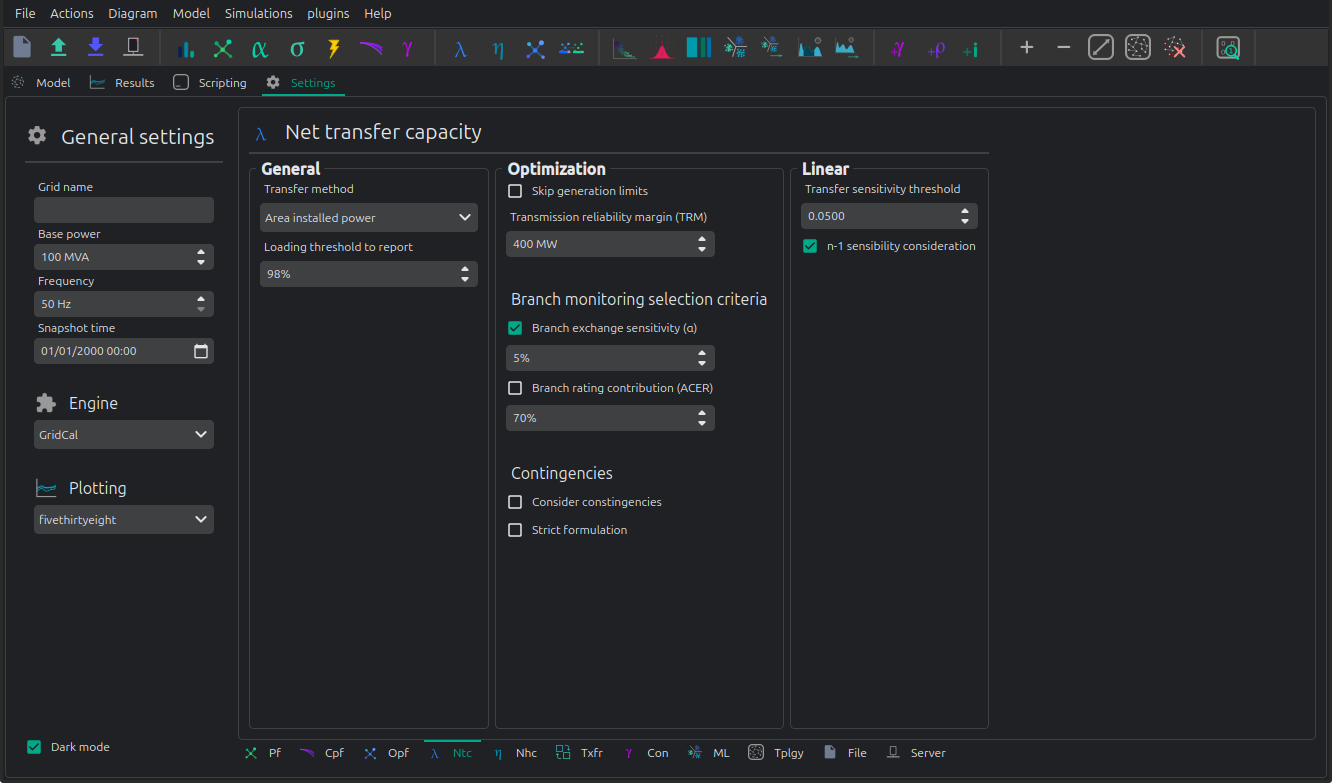
The net transfer capacity optimization is an optimization routine that tries to move as much power between two given areas as possible. This optimization is done using linear programming.
Registered Result Properties
OptimalNetTransferCapacityResults registered properties
The snapshot NTC result stores the optimized transfer state, monitored elements, and contingency report data.
Property |
Type |
Description |
|---|---|---|
|
|
Names aligned with bus-indexed result arrays. |
|
|
Names aligned with branch-indexed result arrays. |
|
|
Names aligned with HVDC line-indexed result arrays. |
|
|
Names aligned with VSC converter-indexed result arrays. |
|
|
Names aligned with contingency group-indexed result arrays. |
|
|
Bus type code used by the solved numerical model. |
|
|
Complex bus voltage solution. |
|
|
Complex bus power injection. |
|
|
Complex bus power-injection increment used by the transfer study. |
|
|
Bus shadow price or nodal marginal value. |
|
|
Load shedding result. |
|
|
Complex branch power flow at the from side. |
|
|
Complex branch power flow at the to side. |
|
|
Overload slack or overload result. |
|
|
Branch loading result. |
|
|
Complex branch losses. |
|
|
Branch phase-shift angle result. |
|
|
Normal monitored element rates. |
|
|
Contingency monitored element rates. |
|
|
Sensitivity of monitored flow to the studied transfer. |
|
|
Monitor-selection logic associated with each monitored element. |
|
|
HVDC result field |
|
|
HVDC result field |
|
|
HVDC result field |
|
|
VSC result field |
|
|
VSC result field |
|
|
VSC result field |
|
|
Convergence flag for the solved case or time step. |
|
|
Computed inter-area flow for the studied transfer. |
|
|
Structural inter-area transfer limit before optimization constraints. |
|
|
List of contingency flow records. |
|
|
Bus indices belonging to the sending side of the transfer. |
|
|
Bus indices belonging to the receiving side of the transfer. |
|
|
Branches connecting the sending and receiving areas. |
|
|
HVDC lines connecting the sending and receiving areas. |
|
|
VSC converters connecting the sending and receiving areas. |
OptimalNetTransferCapacityTimeSeriesResults registered properties
The time-series NTC result stores the optimized transfer state and monitored quantities for each simulated time index.
Property |
Type |
Description |
|---|---|---|
|
|
Time indices represented by the result object. |
|
|
Names aligned with bus-indexed result arrays. |
|
|
Names aligned with branch-indexed result arrays. |
|
|
Names aligned with HVDC line-indexed result arrays. |
|
|
Names aligned with contingency group-indexed result arrays. |
|
|
Bus type code used by the solved numerical model. |
|
|
Complex bus voltage solution. |
|
|
Complex bus power injection. |
|
|
Complex bus power-injection increment used by the transfer study. |
|
|
Bus shadow price or nodal marginal value. |
|
|
Load shedding result. |
|
|
Complex branch power flow at the from side. |
|
|
Complex branch power flow at the to side. |
|
|
Overload slack or overload result. |
|
|
Branch loading result. |
|
|
Complex branch losses. |
|
|
Branch phase-shift angle result. |
|
|
Normal monitored element rates. |
|
|
Contingency monitored element rates. |
|
|
Sensitivity of monitored flow to the studied transfer. |
|
|
Monitor-selection logic associated with each monitored element. |
|
|
HVDC result field |
|
|
HVDC result field |
|
|
HVDC result field |
|
|
VSC result field |
|
|
VSC result field |
|
|
VSC result field |
|
|
Bus indices belonging to the sending side of the transfer. |
|
|
Bus indices belonging to the receiving side of the transfer. |
|
|
Branches connecting the sending and receiving areas. |
|
|
HVDC lines connecting the sending and receiving areas. |
|
|
VSC converters connecting the sending and receiving areas. |
|
|
Convergence flag for the solved case or time step. |
|
|
Computed inter-area flow for the studied transfer. |
|
|
List of contingency flow records. |
AvailableTransferCapacityResults registered properties
The snapshot available-transfer-capacity result currently has no registered persisted properties.
This result object currently does not register persisted result properties.
AvailableTransferCapacityTimeSeriesResults registered properties
The time-series available-transfer-capacity result currently has no registered persisted properties.
This result object currently does not register persisted result properties.
API
import VeraGridEngine as gce

fname = os.path.join('test', 'data', 'grids', 'ACTIVSg2000.veragrid')
grid = gce.open_file(fname)

info = grid.get_inter_aggregation_info(
    objects_from=[grid.areas[6]],  # Coast
    objects_to=[grid.areas[7]]  # East
)

# declare the opf options
opf_options = gce.OptimalPowerFlowOptions(
    consider_contingencies=True,
    contingency_groups_used=grid.contingency_groups
)

# declare the linear analysis options
lin_options = gce.LinearAnalysisOptions()

# declare the NTC options
ntc_options = gce.OptimalNetTransferCapacityOptions(
    sending_bus_idx=info.idx_bus_from,
    receiving_bus_idx=info.idx_bus_to,
    transfer_method=gce.AvailableTransferMode.InstalledPower,
    loading_threshold_to_report=98.0,
    skip_generation_limits=True,
    transmission_reliability_margin=0.1,
    branch_exchange_sensitivity=0.05,
    use_branch_exchange_sensitivity=True,
    branch_rating_contribution=1.0,
    monitor_only_ntc_load_rule_branches=False,
    consider_contingencies=False,
    strict_formulation=False,
    opf_options=opf_options,
    lin_options=lin_options
)

# declate the driver and run
drv = gce.OptimalNetTransferCapacityDriver(grid, ntc_options)
drv.run()

res = drv.results
ntc_no_contingencies = res.inter_area_flows

# check basics from the results
assert abs(res.nodal_balance.sum()) < 1e-6
assert res.converged
assert res.inter_area_flows < res.structural_inter_area_flows
To run a time series of NTC optimizations:
# same inputs as before ...

# declare the time series NTC driver
drv = gce.OptimalNetTransferCapacityTimeSeriesDriver(
    grid,
    ntc_options,
    time_indices=grid.get_all_time_indices()
)
drv.run()

res = drv.results
assert abs(res.nodal_balance.sum()) < 1e-6
assert res.converged.all()
Theory
We decide to compute the injections per node directly. We use a function to summ up all generation present at a node and obtain the power injection limits of that node.
The power increment sent, must be equal to the power increment received:

Where:


Finally, we add the nodal injection to the nodal balance summation

To apply these equations, the generation and the load must be numerically equal in the grid, this is, equal to the complete precision of the computer. This requirement is impossible in real life since there would be losses; However, in this formulation we are forcing everything to be linear and lossless. This means the the summation of the $Pbase` vector must be exactly zero.
- : Node indices of the sending area.
- : Node indices of the receiving area.
- : Power increment at the node i.
- : Power balance at the node i. In the end this will be a summation of terms.
- : scale for the increment at the node i. This is akin to the GLSK’s.
- : Power injection (generation - load) of the base situation at the node i.
Branches
The flow at the “from” node in a branch is:
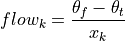
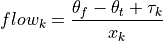
In case of a phase shifter transformer:
We need to limit the flow to the line specified rating:

Finally, we add the flows to the nodal balance summation:


- : index of the node “from”
- : index of the node “to”
- : Nodal voltage angle at the node f.
- : Nodal voltage angle at the node t.
- : Branch k reactance.
- : Branch k power rating.
- : Tap angle of the branch k.
- : Power balance at the node f.
- : Power balance at the node t.
HVDC converters
These are controlled branches for which the flow is determined by a control equation. The $flow_k` value will differ depending on the control mode chosen:
Power control mode
This is the most common control mode of an HVDC converter, where the active power send is controlled and fixed. For out optimization, the variable $flow_k` is an optimization value that moves freely between the +/- rating values.
Angle droop mode (AC emulation)
This is a very uncommon control decision solely used by the INELFE HVDC between Spain and France. It is uncommon because the DC equipment is made to vary depending on an AC magnitude measured as the difference between the AC voltage angle at the AC sides of both converters. This can only work because the two areas are also joined by AC lines already.
For the purpose of running an old-fashioned ac power flow, this is very convenient, since we don’t need to come up with a proper DC formulation using voltage magnitudes on top of using the classic linear formulations based on susceptances and angles.
This mode, introduces some complexity; The angles are only coupled by the expression “$y`” when the converter power is within limits, otherwise the converter flow is set to the maximum value and the angles are set free. This is of course because of the artificial coupling imposed by the math, since in reality the voltage angles are independent of this of that control mode. To appropriately express this, we need to use a piece-wise function formulation:

To implement this piecewise function we need to perform a serious amount of MIP magic.
Selector constraint:

Linear flow expression:

Lower flow definitionNegative flow saturation:
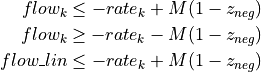
Mid-range: the droop operation zone:
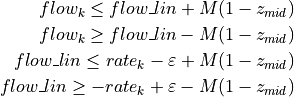
Upper flow definitionNegative flow saturation:
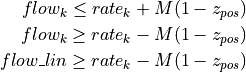
 : Arbitrary control parameter used.
 : Base power (i.e. the given market exchange for the line).
 : real variable to be computed
 : Auxiliary variable.
- : maximum allowable flow in either direction
 : large constant for Big-M logic (e.g., $M \ge 2 \cdot rate`)
 : small tolerance for strict inequalities
$z_{neg}, z_{mid}, z_{pos} \in {0, 1}`
Finally, we add the flows to the nodal balance summation, just like we would with the branches:
Nodal balance
To respect the nodal flows, we create constraints where every nodal power summation is equal to zero to fulfill the Bucherot theorem: All power summation at a node is zero.
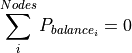
The expressions contained in will be dependent on the angles
 because of the branches and HVDC formulations.
Therefore, the angles will be solved by the optimization too.
However, we must take care to set the slack angles to exactly zero:
because of the branches and HVDC formulations.
Therefore, the angles will be solved by the optimization too.
However, we must take care to set the slack angles to exactly zero:
