🎲 Stochastic power flow
The stochastic power flow in VeraGrid evaluates the network under many sampled operating points instead of solving only one deterministic case. Its purpose is to estimate how uncertainty in injections propagates to voltages, branch flows, loading, and losses.
Rather than asking “what happens for one dispatch and one load level?”, this study asks “what is the distribution of results over many plausible operating points?”.
What The Study Evaluates
For each sampled operating point, VeraGrid runs a power flow and stores the resulting:
bus injections
bus voltages
branch powers
branch loadings
branch losses
After all samples are processed, the study compiles aggregate statistics and distribution views, such as:
average voltage
voltage standard deviation
voltage CDF
branch loading average
branch loading standard deviation
branch loading CDF
branch losses average and CDF
This makes the study useful for uncertainty analysis, risk screening, and probabilistic operating assessment.
Where The Uncertainty Comes From
The stochastic input builder uses the grid time-series information:
fixed injections are sampled from empirical cumulative distributions built from the time-series profiles
dispatchable injections are reconstructed from the sampled fixed injections through a regression model
the dispatchable part is then scaled so that sampled demand and generation remain balanced
In practice, this means the stochastic study is not generating arbitrary random injections. It is generating injections consistent with the historical or profile-based operating patterns already present in the grid model.
Sampling Modes
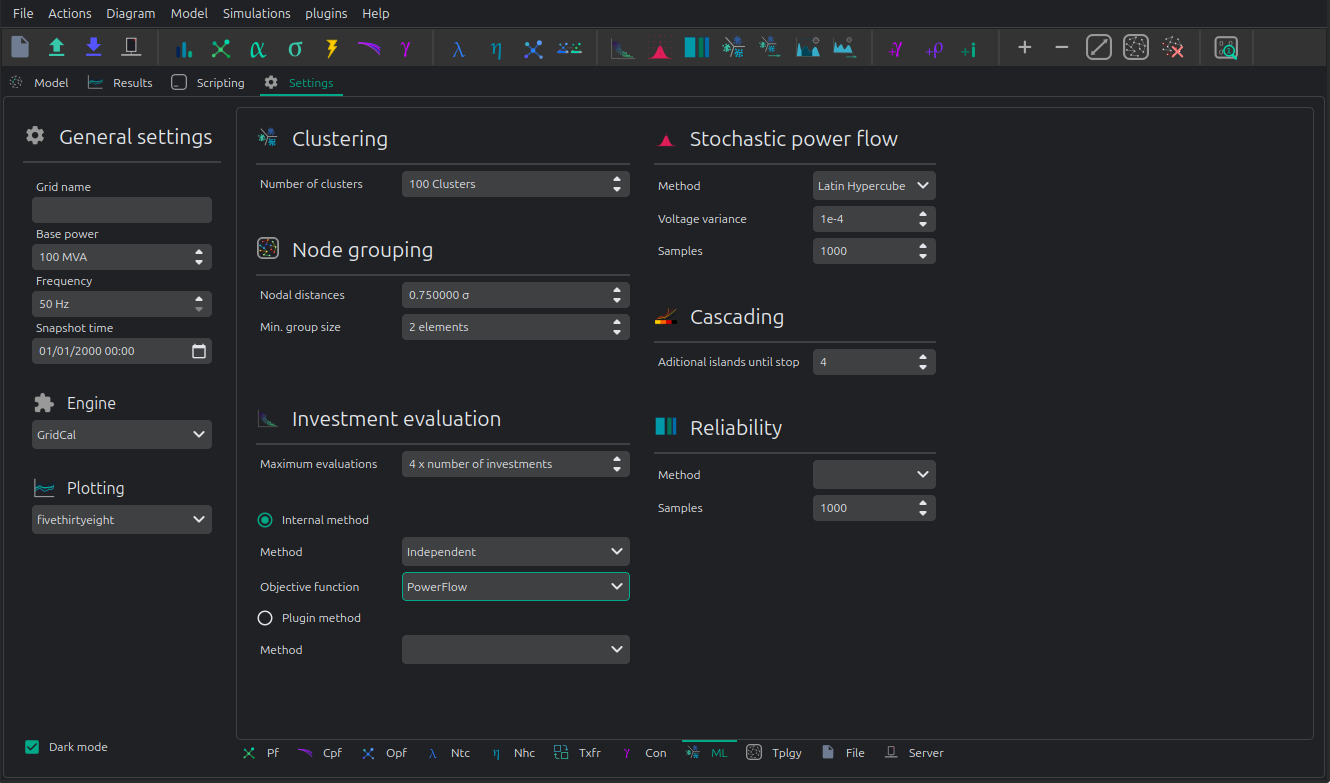
VeraGrid currently supports two sampling modes:
Monte Carlo: random sampling from the empirical distributions
Latin Hypercube: stratified sampling designed to cover the input space more evenly with fewer samples
The corresponding API enum is StochasticPowerFlowType:
StochasticPowerFlowType.MonteCarloStochasticPowerFlowType.LatinHypercube
In general:
use Monte Carlo when you want a straightforward random simulation
use Latin Hypercube when you want better coverage of the sampled uncertainty space for a fixed sample budget
Main Parameters
mc_tol: convergence target for the Monte Carlo error indicatorbatch_size: batch size parameter for the simulation workflowsampling_points: maximum number of sampled operating pointssimulation_type: sampling method, either Monte Carlo or Latin Hypercubeoptions: the deterministic power flow options used for each sampled operating point
The study stores all sampled points and then compiles summary statistics from them.
Reported Results
The StochasticPowerFlowResults object stores the sampled raw data as well as compiled aggregate outputs.
Raw Sampled Arrays
S_points: sampled bus power injectionsV_points: sampled bus voltagesSbr_points: sampled branch powersloading_points: sampled branch loadingslosses_points: sampled branch losses
Compiled Aggregate Arrays
voltage: average bus voltage magnitudesbranch: average branch active powerloading: average branch loadinglosses: average branch losses
Convergence Series
The result object also stores the evolution of averages and variances as the number of samples increases:
v_avg_conv,v_std_convs_avg_conv,s_std_convl_avg_conv,l_std_convloss_avg_conv,loss_std_conv
These are useful to assess whether the stochastic estimates are stabilizing as more samples are added.
Distribution Views
The stochastic result model exposes several result tables through mdl():
ResultTypes.BusVoltageAverageResultTypes.BusVoltageStdResultTypes.BusVoltageCDFResultTypes.BusPowerCDFResultTypes.BranchPowerAverageResultTypes.BranchPowerStdResultTypes.BranchPowerCDFResultTypes.BranchLoadingAverageResultTypes.BranchLoadingStdResultTypes.BranchLoadingCDFResultTypes.BranchLossesAverageResultTypes.BranchLossesStdResultTypes.BranchLossesCDF
The CDF results are especially useful when the question is probabilistic, for example:
what is the probability that a branch exceeds 100% loading?
how likely is a bus voltage to fall below a threshold?
how dispersed are branch losses under uncertain operating conditions?
Additional Helper Methods
The results object includes a few practical helper methods:
get_index_loading_cdf(max_val=1.0): finds branches whose loading distribution exceeds a threshold and returns their indices and associated probabilitiesquery_voltage(power_array): estimates voltages for a new injection vector using a regression model trained on the sampled points
The first helper is particularly relevant for risk screening and is also reused by the cascading simulation.
Interpretation Notes
A low average branch loading does not necessarily mean low risk if the loading CDF has a long upper tail.
A small voltage standard deviation means the bus voltage is robust to the sampled uncertainty.
A broad CDF spread usually indicates that the corresponding variable is highly sensitive to uncertain injections.
The quality of the stochastic study depends strongly on the quality and representativeness of the time-series data.
As with any probabilistic study, the outputs are only as meaningful as the input distributions.
Registered Result Properties
StochasticPowerFlowResults registered properties
The stochastic power-flow result currently has no registered persisted properties.
This result object currently does not register persisted result properties.
API
Using the driver directly:
import VeraGridEngine as vg
from VeraGridEngine.Simulations.PowerFlow.power_flow_options import PowerFlowOptions
from VeraGridEngine.Simulations.Stochastic.stochastic_power_flow_driver import (
    StochasticPowerFlowDriver,
    StochasticPowerFlowType,
)

grid = vg.open_file("my_grid.veragrid")

drv = StochasticPowerFlowDriver(
    grid=grid,
    options=PowerFlowOptions(),
    sampling_points=1000,
    simulation_type=StochasticPowerFlowType.LatinHypercube,
)
drv.run()

results = drv.results

print("Average bus voltage magnitudes:", results.voltage)
print("Average branch loading:", results.loading)
print("Average branch losses:", results.losses)
Using plain Monte Carlo sampling:
import VeraGridEngine as vg
from VeraGridEngine.Simulations.PowerFlow.power_flow_options import PowerFlowOptions
from VeraGridEngine.Simulations.Stochastic.stochastic_power_flow_driver import (
    StochasticPowerFlowDriver,
    StochasticPowerFlowType,
)

grid = vg.open_file("my_grid.veragrid")

drv = StochasticPowerFlowDriver(
    grid=grid,
    options=PowerFlowOptions(),
    mc_tol=1e-3,
    sampling_points=5000,
    simulation_type=StochasticPowerFlowType.MonteCarlo,
)
drv.run()

print("Computed samples:", drv.results.points_number)
print("Error series length:", len(drv.results.error_series))
Getting a result table:
from VeraGridEngine.enumerations import ResultTypes

table = results.mdl(ResultTypes.BranchLoadingCDF)
print(table.data)
Finding overloaded branches probabilistically:
idx, val, prob, loading = results.get_index_loading_cdf(max_val=1.0)

print("Candidate branch indices:", idx)
print("Overload probabilities:", prob)
The main constructor arguments are:
grid: theMultiCircuitnetwork modeloptions: power flow optionsmc_tol: Monte Carlo convergence tolerancebatch_size: batch size parametersampling_points: maximum number of samplessimulation_type:StochasticPowerFlowType.MonteCarloorStochasticPowerFlowType.LatinHypercube
Practical Guidance
Use Latin Hypercube when you want a compact but well-spread exploration of uncertainty.
Use a larger
sampling_pointsvalue when estimating tail probabilities or overload risk.Check the CDF outputs, not only the averages, when the study is meant for risk assessment.
Make sure the grid contains representative time-series data, otherwise the sampled operating points will not be meaningful.
Use the deterministic power flow first if you need to debug convergence issues before launching the stochastic study.